Victor Johnson
Artificial intelligence has changed how people write content, develop software, analyse information and automate everyday tasks. As large language models (LLMs) become part of more applications, two terms frequently appear in discussions about improving AI performance: prompt engineering and context engineering. Both influence how an AI model responds, but they address different parts of the problem.
For a long time, getting better results from AI largely meant writing better prompts. Developers experimented with instructions, examples and response formats to guide models towards the desired output. However, modern AI applications often need more than instructions. They may require access to documents, previous conversations, databases, external tools and information that changes while a task is being completed.
This has made context engineering increasingly important, particularly for AI agents and applications that perform multiple steps. But does context engineering replace prompt engineering? Are they simply different names for the same technique? Understanding how they differ can help developers and everyday AI users choose the right approach without introducing unnecessary complexity.
What Is Prompt Engineering?
Prompt engineering is the process of designing and improving instructions given to an AI model to produce more useful, accurate and consistent responses. A prompt communicates what the model should do, how it should approach the task and what the final response should look like.
Consider someone asking an AI assistant to explain cloud computing. A basic request such as “Explain cloud computing” leaves several decisions to the model. It does not specify the intended audience, level of technical detail or preferred format. The model may provide a technically correct explanation that is too complicated for a beginner.
A more carefully designed prompt could ask the model to explain cloud computing to someone without a technical background, use a familiar example and keep the response under 200 words. The additional instructions help establish expectations without changing the underlying model.
Prompt engineering can involve assigning roles, defining constraints, providing examples and specifying output structures. Developers may also test different prompt versions to identify which instructions produce more reliable results across repeated tasks.
How Does Prompt Engineering Work?
Prompt engineering works by reducing ambiguity in the instructions a model receives. Rather than expecting the AI to determine every requirement independently, the prompt establishes the task, relevant boundaries and expected output.
For example, a developer building a customer feedback classifier might instruct an AI model to categorise each review as positive, negative or neutral. The prompt could also specify how to handle mixed opinions and require the output in JSON format. These instructions help the model produce responses that are easier for another application to process.
Another common technique is few-shot prompting, where the model receives examples of inputs and their expected outputs. This can be useful when a task involves a particular classification system, writing style or formatting convention.
However, prompt engineering has limitations. Even a carefully written instruction cannot guarantee a correct answer when the model lacks the information needed to complete the task. This is where managing the wider context becomes important.
What Is Context Engineering?
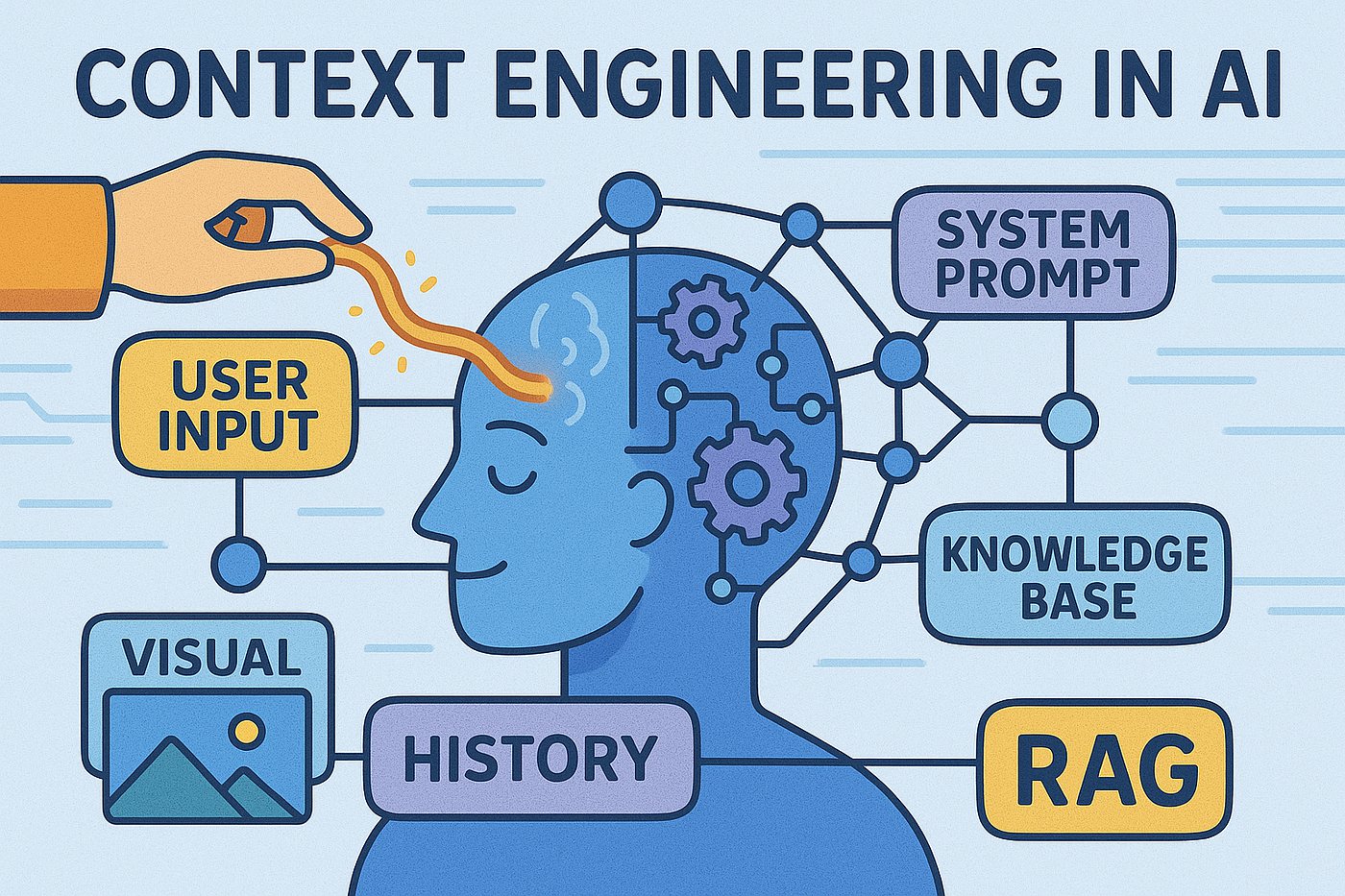
Context engineering is the practice of selecting, organising and maintaining the information an AI model needs to complete a task effectively. Instead of concentrating mainly on how instructions are written, it considers the wider collection of information available to the model when generating a response. Read more about context engineering in my previous article
This information can include the current user request, system instructions, relevant documents, conversation history, stored memory, retrieved knowledge and results returned by external tools.
Imagine an AI assistant helping a customer track an online order. The instruction “Provide an accurate delivery update” explains the task, but it does not provide the order status. The assistant needs access to the relevant order record, delivery information and possibly the latest courier update.
Context engineering helps ensure that the model receives those details when they are needed. It also determines which information should be excluded, updated or summarised as the interaction continues.
The objective is not to provide as much information as possible. Large amounts of irrelevant or conflicting content can make a task more difficult. Effective context engineering focuses on providing the right information at the right stage of the task.
How Does Context Engineering Work?
Context engineering usually involves identifying the information required for a task, retrieving it from suitable sources and preparing it for the model. The application may also need to update the available information as new events occur.
For example, an AI coding assistant asked to investigate a failing test might need the error message, relevant source files, test configuration and recent code changes. Sending the entire project history may introduce unnecessary information and increase processing costs.
A context engineering process can select the files most closely related to the failure, preserve important findings and retrieve additional information when the investigation requires it.
For applications that run across multiple steps, context management becomes an ongoing activity. Completed actions, decisions and unresolved problems may need to remain available, while outdated search results and temporary tool outputs can be removed.
Techniques such as Retrieval-Augmented Generation (RAG), selective memory retrieval, context summarisation and structured task state can support this process.
Is Context Engineering the Same as Prompt Engineering?
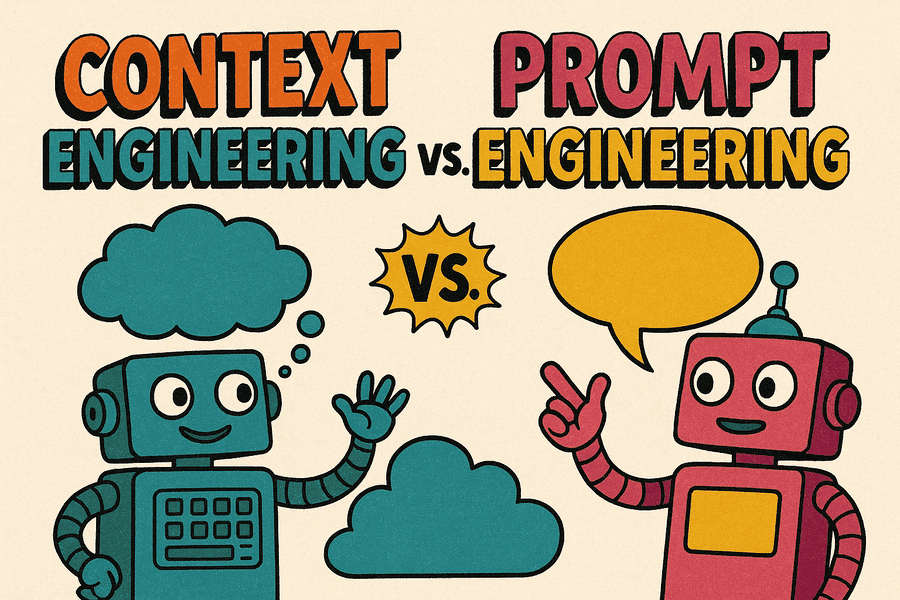
No. Context engineering and prompt engineering are closely related, but they are not identical. Prompt engineering primarily addresses how an AI model is instructed, while context engineering manages the broader information supplied to that model.
A useful way to understand the relationship is to imagine preparing a presentation. The instructions explain the topic, audience and expected structure. However, completing the presentation also requires the correct research material, figures and supporting evidence.
Prompt engineering is similar to defining the presentation requirements. Context engineering is similar to preparing and maintaining the information needed to satisfy those requirements.
The two approaches overlap because instructions are themselves part of the model’s context. In many AI architectures, prompt engineering can be considered one component of the broader context engineering process.
This does not mean prompt engineering has become obsolete. A system may have access to all the relevant information and still produce an unsuitable response if the instructions are unclear. Equally, excellent instructions cannot reliably compensate for missing or outdated information.
Context Engineering vs Prompt Engineering: Key Differences
| Aspect | Prompt Engineering | Context Engineering |
|---|---|---|
| Main focus | Designing effective instructions | Managing the information available to the model |
| Primary objective | Guide model behaviour and output | Provide relevant information for the current task |
| Typical inputs | Roles, instructions, examples and formatting rules | Prompts, documents, memory, tool results and task state |
| Scope | Usually a prompt or instruction template | The wider AI application and its information flow |
| Common techniques | Few-shot prompting, role instructions and structured outputs | RAG, retrieval filtering, memory selection and summarisation |
| Typical use cases | Writing, classification, summarisation and structured responses | AI agents, knowledge assistants and multi-step workflows |
| Main challenge | Ambiguous or ineffective instructions | Missing, outdated, excessive or conflicting information |
| When information changes | Prompts may need revised inputs | Relevant context may be refreshed during execution |
| Complexity | Often relatively simple to introduce | May require additional application components |
| Relationship | Helps define how the model should respond | Manages what information the model receives, including prompts |
The distinction becomes especially important when diagnosing poor AI responses. If the model misunderstands the requested format, the prompt may need improvement. If the model follows the instructions but uses incorrect information, the problem may involve retrieval, data quality or context management.
A Practical Example of Prompt Engineering vs Context Engineering
Consider an AI assistant that prepares a monthly sales report for an online business. The report should explain revenue changes, identify important product trends and highlight areas requiring attention.
With prompt engineering, the developer might instruct the assistant to write a professional report, compare the current month against the previous month and present the findings under three headings. The prompt could also require the assistant to distinguish facts from recommendations.
These instructions establish how the report should be prepared. However, they do not supply the actual sales figures.
Context engineering addresses that missing information. The application could retrieve the relevant sales records, product performance data and previous reporting period. It might also check that the figures belong to the correct business and that the reporting dates match the user’s request.
The model can then use the retrieved information while following the instructions established through prompt engineering.
If the user later requests a comparison with the same month last year, the application may need to retrieve another dataset. Changing the wording of the original prompt alone would not provide those historical figures.
This example illustrates the difference between telling an AI what to do and supplying the information it needs to do it.
When Should You Use Prompt Engineering?
Prompt engineering is often the most practical starting point when the task is clearly defined and the necessary information is already available. It can improve results without requiring additional databases, retrieval systems or memory components.
For everyday AI interactions, a well-structured prompt may be sufficient. Asking an AI assistant to rewrite an email, explain a programming concept or summarise supplied text generally does not require a complex context management system.
Prompt engineering is also valuable in applications where output consistency matters. A model that extracts information from invoices, classifies customer feedback or generates structured descriptions may benefit from precise instructions and carefully selected examples.
When Prompt Engineering Works Best
Prompt engineering is particularly useful when the main challenge involves the model’s behaviour rather than access to information.
For example, an organisation might need an AI assistant to convert customer messages into a fixed JSON structure. The input messages are already available, and the required output is predictable. Clear instructions, examples and validation rules may be enough to support the task.
It is also useful when developing prototypes. Before introducing a retrieval pipeline or persistent memory, developers can test whether a model can complete the intended task using a direct prompt and the information already provided.
For tasks involving writing style, tone, explanations, transformations and predefined response formats, prompt engineering can offer a relatively straightforward solution.
When Should You Avoid Relying Only on Prompt Engineering?
Prompt engineering should not be treated as the complete solution when a task depends on information the model has not received.
For example, asking an AI assistant to identify the current inventory level of a product will not produce a reliable answer unless the relevant inventory data is available. Rewriting the question repeatedly does not solve the underlying information problem.
Prompt engineering alone is also insufficient when an application needs to remember decisions across long workflows, access frequently changing records or combine evidence from multiple systems.
In these situations, instructions remain important, but additional information management is required.
The goal is not to avoid prompt engineering itself. It is to recognise when improving the prompt will no longer address the main cause of incorrect or incomplete responses.
When Should You Use Context Engineering?
Context engineering becomes especially useful when an AI application depends on external information, previous interactions or a changing task environment.
An AI research assistant may need to retrieve documents, compare sources and retain findings throughout an investigation. A customer support agent may need access to authorised account information, relevant policies and earlier troubleshooting steps. A coding agent may need to inspect different files as it works through a software issue.
In each case, the information required by the model can change during the task. A fixed prompt containing every possible detail would be difficult to maintain and could introduce unnecessary content.
Context engineering provides a way to manage these changing requirements more deliberately.
When Context Engineering Works Best
Context engineering is valuable for AI agents that perform multiple actions rather than generating a single response. These agents may use tools, retrieve data, make intermediate decisions and continue working after receiving new information.
It is also important for Retrieval-Augmented Generation applications. A knowledge assistant answering questions about internal company policies needs access to relevant documents, but retrieving the wrong document can lead to an incorrect answer even when the prompt is clear.
Applications that maintain conversation history or persistent memory can benefit from selective context management. Instead of repeatedly supplying every previous interaction, the system can retain relevant preferences, decisions and task details.
Context engineering can also support applications with strict information access requirements. However, actual permissions must be enforced by the underlying systems. Simply instructing a model not to reveal restricted information is not a substitute for proper access controls.
When Is Context Engineering Unnecessary or Excessive?
Not every AI application requires an advanced context engineering pipeline.
If a user asks an AI model to improve the grammar of a short paragraph, the paragraph and a clear instruction may provide everything required. Adding a vector database, retrieval system or persistent memory would introduce complexity without an obvious benefit.
The same applies to many straightforward tasks involving translation, basic explanations, text classification and formatting. If the necessary information is already present, additional retrieval may increase latency and cost.
Context engineering can also become counterproductive when applications retrieve excessive amounts of information without checking relevance. More documents do not automatically produce better answers. Irrelevant material may distract the model, while conflicting sources can make the response less dependable.
A practical approach is to begin with the simplest design that meets the task’s requirements and introduce additional context management only when there is a clear reason.
Can Prompt Engineering and Context Engineering Work Together?
Yes. In many AI applications, prompt engineering and context engineering work best as complementary practices rather than competing alternatives.
Prompt engineering establishes what the model is expected to do. Context engineering helps ensure that the model receives the information required to complete that task.
Consider an AI travel assistant preparing a personalised itinerary. Prompt engineering can define the response structure, require a realistic schedule and instruct the assistant to account for the traveller’s budget.
Context engineering can provide the destination, travel dates, accommodation details, relevant preferences and current information retrieved from suitable sources.
As the traveller changes plans, the application can update the relevant context while retaining the instructions that govern how the itinerary should be prepared.
The result is an AI system that combines clear behavioural guidance with information appropriate to the current request.
Why Combining Both Approaches Matters for AI Agents
AI agents often operate in environments where neither instructions nor information remain completely static. An agent may begin with a broad objective, use a tool to collect evidence, make a decision and then require different information for the next action.
Prompt engineering helps define how the agent should approach its responsibilities, report uncertainty and produce outputs. Context engineering helps maintain task continuity and supplies relevant information as the workflow progresses.
For example, a software development agent may receive instructions to fix a bug without changing unrelated functionality. During execution, it may need to inspect the failing test, source code, configuration and results of subsequent test runs.
The instructions guide its behaviour, while the evolving context supports its decisions.
Both approaches also require evaluation. Developers should test whether instructions are being followed and whether the information supplied to the model is relevant, accurate and sufficient.
Common Mistakes When Using Prompt Engineering and Context Engineering
One common mistake is assuming that a longer prompt will always produce a better response. Additional instructions can help when they clarify a task, but unnecessary detail may introduce contradictions or make important requirements harder to identify.
Another mistake is treating context engineering as the process of inserting every available document into the model’s context window. This approach can increase token usage and processing costs without improving accuracy. Relevant information should be selected according to the current task.
Developers may also confuse missing information with poor instructions. If an AI assistant cannot answer a question about a recent database update, the solution may involve retrieving the latest records rather than rewriting the prompt.
Outdated information presents another challenge. A model may follow instructions correctly while relying on an old policy or previous application state. Context engineering should account for when information was collected and whether it remains valid.
Finally, neither approach should be mistaken for a complete security mechanism. Untrusted documents can contain misleading instructions, and sensitive information should not be supplied to a model without appropriate authorisation. Applications need independent access controls, validation and safeguards around tool execution.
How to Choose Between Prompt Engineering and Context Engineering
The choice depends on what is preventing the AI model from completing the task successfully.
If the required information is already available but the model produces responses in the wrong format, misunderstands the objective or fails to follow important constraints, prompt engineering is a sensible starting point.
If the model understands the task but lacks documents, current facts, previous decisions or information returned by external tools, context engineering is likely to be more relevant.
For applications involving both challenges, the answer is not to select one approach exclusively. Developers can improve the instructions while also refining how information is retrieved and supplied.
A simple AI writing assistant may only need a carefully designed prompt. A company knowledge assistant may require prompts alongside document retrieval. A long-running AI agent may need instructions, retrieval, memory management, structured state and regular context updates.
The most effective design is generally the least complicated approach that reliably satisfies the application’s requirements.
Does Context Engineering Replace Prompt Engineering?
The growing importance of context engineering does not mean prompt engineering is becoming irrelevant. Instead, it reflects the increasing complexity of applications built around large language models.
Earlier AI applications often focused on isolated interactions, where users supplied a request and received a response. In those situations, prompt design could account for much of the work needed to improve results.
Modern AI systems increasingly interact with external tools, organisational data and multi-step workflows. These applications require developers to consider not only the instructions given to a model but also the information available throughout execution.
Context engineering extends this thinking to the wider application. It addresses how information is selected, updated and maintained while the model works.
Prompt engineering remains an essential part of that process. Clear instructions are still necessary even when an application has access to accurate and relevant data.
Rather than viewing one approach as the replacement for the other, it is more useful to understand context engineering as a broader discipline that includes prompt design alongside information management.
Final Thoughts: Which Approach Is Better?
There is no universal winner in the comparison between context engineering and prompt engineering. Each addresses a different requirement, and their usefulness depends on the task being performed.
Prompt engineering is most useful when the model needs clearer instructions. Context engineering becomes important when the model needs better access to relevant information.
For simple tasks with complete inputs, prompt engineering may be sufficient. For AI agents, knowledge-based assistants and applications that depend on changing information, context engineering often plays a larger role.
The important question is not whether context engineering is better than prompt engineering. It is whether the AI system has both the instructions and the information required to complete its task.
As AI applications become more capable, understanding this distinction will help developers build systems that are easier to maintain, more efficient and better suited to real-world requirements.
Frequently Asked Questions
Is context engineering just advanced prompt engineering?
Not exactly. Prompt engineering focuses on designing instructions, while context engineering manages the wider information supplied to a model. Context engineering can include prompt design, but it also involves retrieval, memory, tool outputs and application state.
Is prompt engineering still relevant for AI agents?
Yes. AI agents still need clear instructions defining their objectives, constraints and expected behaviour. Context engineering complements those instructions by managing the information the agent needs during execution.
Which is easier to learn, prompt engineering or context engineering?
Prompt engineering is generally easier to begin with because it can be practised through direct interactions with AI models. Context engineering often requires additional knowledge of retrieval systems, data management, application architecture and agent workflows.
Does context engineering require RAG?
No. Retrieval-Augmented Generation is one technique used in context engineering, but it is not mandatory. Context engineering can also involve managing conversation history, selecting tool outputs, maintaining task state and summarising information.
Can context engineering reduce AI hallucinations?
Good context engineering can reduce some unsupported responses by providing relevant evidence and limiting outdated or irrelevant information. However, it cannot guarantee factual accuracy. Retrieval quality, model behaviour, verification and evaluation remain important.
Should beginners learn prompt engineering before context engineering?
Learning prompt engineering first can provide a useful foundation for understanding how instructions influence model behaviour. Once those principles are familiar, context engineering introduces broader concepts such as information retrieval, memory and multi-step AI workflows.
References and Further Reading
For readers interested in the technical foundations and practical applications of these concepts, the following resources provide additional information.
 Context Engineering for AI Agents - What It Is, Why It Matters and How to Implement It